Showing posts with label economics. Show all posts

A corporate with back bone


Google announced, in a carefully worded blog post, that it no longer felt comfortable operating in China. They claimed to have been under serious and protracted cyber attacks from the Chinese government, and that Gmail accounts of advocates of human rights activists have been routinely accessed by third parties.
Privacy and security on the Internet are concepts that the Chinese government regard with annoyance and disdain. Would it be better to work within the limitations and hope for a better day, or to distance oneself from such a depressing place and preserve ones integrity? These are problems that have long confronted foreign companies and local dissidents in China. Some of us (yes, myself included) have to swallow part of our pride every day in order to accept the status quo without going insane. It is simply refreshing to see such an influential corporation behave like a person with honor and integrity. I applauded your decision to establish google.cn four years ago. I applaud your decision to exit the China market now. I hope your action will spark a widespread movement in which companies and politicians would rethink their attitude in dealing with repressive regimes, not limited to China.

How corn became the cornerstone of our food chain, in a nutshell


Cattlemen found that corn, being such a dense source of calories, produced meat more quickly than grass; it also produced a more reliably consistent product, eliminating the seasonal and regional differences you often find in grass-finished beef. Over time, the knowledge that went into growing grass good enough to finish cattle all the year round gradually was lost.

Along the way corn kept getting more plentiful and ever cheaper. When the farmer found that he could buy corn more cheaply than he could ever hope to grow it, it no longer made economic sense to feed animals on the farm, so they moved into CAFOs (Concentrated Animal Feeding Operations, aka factory farms). The farmer who then plowed up his pastures to grow corn to market found he could take off to Florida in the winter, not work so hard. To help dispose of the rising mountain of cheap corn farmers were now producing, the government did everything it could to help wean cattle off grass and onto corn, by subsidizing the building of feedlots (through tax breaks) and promoting a grading system based on marbling that favored corn-fed over grass-fed beef. (The government also exempted CAFOs from most clean air and clean water laws.) In time the cattle themselves changed, as the industry selected for animals that did well on corn; these animals, generally much bigger, had trouble getting all the energy they needed from grass. In dairy, farmers moved to superproductive breeds like the Holstein, whose energy requirements were so great they could barely survive on a diet of grass.

So feeding ruminants corn came to make a certain economic sense— I say “certain” because that statement depends on the particular method of accounting our economy applies to such questions, one that tends to hide the high cost of cheap food produced from corn. The ninety-ninecent price of a fast-food hamburger simply doesn’t take account of that meal’s true cost—to soil, oil, public health, the public purse, etc., costs which are never charged directly to the consumer but, indirectly and invisibly, to the taxpayer (in the form of subsidies), the health care system (in the form of food-borne illnesses and obesity), and the environment (in the form of pollution), not to mention the welfare of the workers in the feedlot and the slaughterhouse and the welfare of the animals themselves. If not for this sort of blind-man’s accounting, grass would make a lot more sense than it now does.


Zimbabwe update - $10 mn bill


A follow up to my previous posts.

Zimbabwe bank to issue $10m bill
By Peter Biles
BBC Southern Africa correspondent

Zimbabwe's central bank is to introduce new higher-denomination banknotes in an effort to ease the critical shortage of cash in the country.

Zimbabwe has been in economic decline for the past eight years, with annual inflation widely thought to be in excess of 50,000%.

The highest value note that will go into circulation on Friday is worth 10m Zimbabwean dollars.

But that is worth less than US$3.90 (£2; 2.60 euros) on the black market.

...

The government's only response is to print more money - and that is seen as the main reason for the hyperinflation.

There have been no official inflation figures published for the past three or four months.

Zimbabwe's Reserve Bank governor, Gideon Gono, has called on the business community not to increase prices every time new measures are taken to adjust the currency.

The Asset Write-down League Table


When I was an analyst in an investment bank, I had to spend a disproportionate amount of time on whipping up the best looking league tables by tweaking various parameters and recording such tweaks in minuscule font. Here is one that no banker would touch with a 10-feet pole:

From Here is the City News
Last updated: 18/01/2008

  1. Citi - $32.1bn
  2. Merrill Lynch - $19.3bn
  3. UBS - $13.7bn
  4. Morgan Stanley - $10.6bn
  5. Credit Agricole (Calyon) - $3.7bn
  6. Barclays Bank - $3.3bn
  7. Deutsche Bank - $3.2bn
  8. Bank of America - $3bn
  9. JPMorgan - $3bn
  10. Bear Stearns - $2.8bn
  11. Royal Bank of Scotland - $2.5bn
  12. Credit Suisse - $2bn
  13. Goldman Sachs - $1.7bn
  14. Lehman Brothers - $1.5bn
  15. WestLB - $519m

The worst is yet to come, my dear friends.

BRACE! BRACE!

Welcome to America – The Saudi Arabia of Coal


Photo by James NachtweyAn excellent article from last week's GQ. A very humane look into the miners of America. While us Chinese people are tragically used to hearing about mining accidents that killed dozens of people in the news every now and then, this industry is largely forgotten in the developed world. However, with a quarter of the world's reserve of coal, the United States employs over 80,000 miners in extracting the "freedom fuel" from its land everyday.

Coal, if it disappeared from the nation's consciousness, never went away. This is America, and this is our fossil fuel, a $27.6 billion industry that employs nearly 80,000 miners in twenty-six states. We are sitting on 25 percent of the world's supply—the “Saudi Arabia of Coal!”—and lately we've been grabbing it in record amounts, gorging on the black rock the Bush administration calls "freedom fuel."

The question I had going in was almost ridiculous in nature: If coal is really this big, and all these people really exist, how is it that I know nothing about them?

The ceiling is five feet high, and so you can’t, actually, stand up. You look around and everyone is walking around like the freaks in Being John Malkovich. “Okay, they should make it higher,” I said to Foot the first time I experienced this. I wanted to call a congressman or something. This was ridiculous. There are people in here! Everyone’s doing a duck walk, hands clasped behind their backs to give the body balance as they lean over and waddle. You work your whole ten-hour shift like that, duck-walking through the darkness, nothing but a pinpoint of light shining from your hat to tell you which rat tunnel is which. A rat. You feel like a rat.

Seriously, play this game


This is the second game I've come across that's extremely addictive and sufficiently educational to make me feel less guilty about indulging myself in the game. (The other one was the 3rd World Farmer.) I am very proud to report that I have managed to keep my family alive over the four years while saving quite a bit of money in the process.

Apparently there is a rather drab term for this kind of games - serious games.

(Via the WB's PSD Blog)

Steven Levitt on crack cocaine and gangsters' lives


Steven Levitt, author of Freakonomics and economics professor at the University of Chicago, discussed his research on crack cocaine and the lives of gang members at TED2004. This is one of the rare academic seminars in which people laugh and actually enjoy the presentation.

Video link
(Via Greg Mankiw's blog, which is an excellent source of daily commentary on current affairs from an economist's perspective.
Prof Mankiw wrote what are probably the most popular economics college textbooks
and was the chairman of George W. Bush's Council of Economic Advisors from 2003 to 2005.)

Hyperinflation in Zimbabwe


As a follow up to my previous post.

Bags of bricks

Aug 24th 2006 | JOHANNESBURG
From The Economist print edition

A most unusual shopping spree has just taken place in Zimbabwe. At the end of July the central bank devalued the Zimbabwean dollar (Z$) by more than half and then announced that the currency would also lose three zeros. This is the bank's latest idea to fight hyperinflation hovering around 1,000% a year—the highest in the world—and to attract cash into the banking system. Zimbabweans had until August 21st to get rid of the old bearer cheques used as banknotes. Whatever they could not exchange for the new currency, they spent. Gideon Gono, the governor of the central bank, suggested that the change be called “from zero to hero”.
Banks were swamped with customers trying to hand in their cash before the deadline. Anyone willing to deposit more than Z$100m ($400) a week—Z$5 billion for businesses—had to explain where the money came from or risk having it forcibly converted into one-year bonds or confiscated. New bearer cheques could be withdrawn against what had been deposited, subject to strict ceilings. The police searched people for large amounts of cash at roadblocks. Those stuck with extra money had to spend it before it became worthless. Shoppers frantically filled trolleys before the deadline.

In June it could buy a loaf of bread. Now it is worthlessSpiralling inflation has forced Zimbabweans to use bags to carry cash: wallets are a distant memory. It takes time for cash machines to spit out the daily maximum of Z$250m—or Z$250,000 in new money—that people are allowed to withdraw, so queues have become common. Zimbabweans have become used to dealing in “bricks”, as piles of banknotes worth Z$10m are known. Businesses send their money by trucks to banks' special bulk-cash facilities. Computer and accounting systems have been close to collapse, struggling to cope with sums in the trillions.

It is hard to see how scrapping three zeros and forcing people to bank their cash will stop prices spiralling. The central bank is calling for stringent monetary and fiscal policy, but has no power to force the government to tighten the purse strings. It partly blames inflation on speculation in the property and parallel foreign-exchange markets, but it has shown little restraint in printing money. Zimbabwe, the region's breadbasket before the government launched a disastrous land reform in 2000, is now hobbled by shortages of food, petrol, other basic commodities and hard currency. The economy has been contracting fast, and unemployment is estimated at over 70%. Many Zimbabweans rely on support from the 3m relatives or friends thought to have left the country.

Zimbabwe's woes cast serious doubt over the integration plans of the 14-country Southern African Development Community, which held a summit in Lesotho last week. Those attending voiced concern over Zimbabwe, which used to be the region's second-largest economy after South Africa. But it ended with the usual promises to speed up integration, create a free-trade zone within two years and establish a common currency by 2018. A common market, let alone a monetary union, looks like a distant dream. Probably not for the central bank's Mr Gono though: he expects Zimbabwe to have single-digit inflation by the end of 2008.

Correlation between Chinese population size and wealth


"Because of the entrepreneurial drive of Chinese immigrants, the more Chinese a country has, the richer it becomes." Interesting...
  • Burma: 3% Chinese, $157 per capita GDP
  • Cambodia: 1.2% Chinese, $341 per capita GDP
  • Laos: 1% Chinese, $396 per capita GDP
  • Vietnam: 3% Chinese, $518 per capita GDP
  • Philippines: 2% Chinese, $1,021 per capita GDP
  • Indonesia: 3.1% Chinese, $1,100 per capita GDP
  • Thailand: 12% Chinese, $2,845 per capita GDP
  • Malaysia: 25% Chinese, $5,003 per capita GDP
  • Singapore: 76.8% Chinese, $24,620 per capita GDP

A US$160 watermelon


Wow!

Picture taken at Taste, the upscale Park'n Shop (one of Hong Kong's two largest supermarket chains) in Festival Walk.
  • Sign on top of the watermelon in the right: "Japanese Watermelon, $498 per piece"
  • Sign on the right: "Japanese Square Watermelon, $1280 per piece"

Exchange rate is HK$7.8 to US$1.

Climate Control, Beijing-Style


By Melinda Liu
Newsweek International
June 4, 2006

The rainy season has come to northern China, and it’s a brave new world out there. Actually the natural rainy season doesn’t start until July. But the season of man-made rain is upon us, and Chinese rainmakers have been busy. Over the past month they've mobilized cloud-seeding aircraft, artillery and rockets to enhance rainfall. "We've ordered technicians to try to make it rain again today, but so far they haven’t reported back on the results," says Zhang Qiang, a businesslike woman who heads the Beijing Weather Modification Office (yes, that’s the official name of a real Chinese government agency). "We did it many times last week to increase the rainfall."

Not content with simply making it rain, now China's weather modifiers have taken on another meterological mission: to help guarantee perfect weather when Beijing hosts the Olympic Games in 2008.

Zhang's office, which employs 30 people, is part of the Beijing municipal government and the nationwide China Meteorological Administration. Her unit uses two aircraft and 20 artillery and rocket-launching bases to help modify weather around the city. Springtime is the busiest season for agricultural purposes. But more and more, Zhang and her colleagues are experimenting with weather modification to try to create blue skies. Toward this end, they’ve spent nearly a month and a half total researching the effects of certain chemical activators on different sizes of cloud formations and at different altitudes. Chinese meteorologists claim that similar efforts helped create good weather for a number of past VIP events in China, including the World Expo in Yunnan, the Asian Games in Shanghai and the Giant Panda Festival in Sichuan.

And why not? The central-government leadership—dominated by engineers—has been messing with Mother Nature ever since the Chinese Communist Party came to power. They’ve built the world’s biggest dam, the world’s highest railway and even the world’s biggest Ferris wheel (in Nanchang, still awaiting verification from the Guinness World Records). Why not perfect the science of climate control?

Today Chinese rainmakers are among the world’s busiest. Beijing's nationwide weather-modification budget exceeds $50 million a year. The communist regime’s 11th Five Year Plan, which kicked off this year, calls for the creation of 48 billion to 60 billion cubic meters of artificial rain annually (somewhere between 12 trillion to 16 trillion gallons of water). Beijing needs it. Right now is when fruit trees and crops need life-giving water; the parched North China plain has been stalked by drought since 1998. Normal precipitation is between 22 and 24 inches annually, says Zhang, but Beijing had only 18 inches last year.

Essential readings before WC2006 starts


How Bad Is Inflation in Zimbabwe?


Very bad.
Toilet paper costs $417. No, not per roll. Four hundred seventeen Zimbabwean dollars is the value of a single two-ply sheet. A roll costs $145,750 — in American currency, about 69 cents.

By March [2006], inflation had touched 914 percent a year, at which rate prices would rise more than tenfold in 12 months. Experts agree that quadruple-digit inflation is now a certainty.
Zimbabwe has been tormented this entire decade by both deep recession and high inflation, but in recent months the economy seems to have abandoned whatever moorings it had left. The national budget for 2006 has already been largely spent. Government services have started to crumble.

Zimbabwe's inflation is hardly history's worst — in Weimar Germany in 1923, prices quadrupled each month, compared with doubling about once every three or four months in Zimbabwe. That said, experts agree that Zimbabwe's inflation is currently the world's highest, and has been for some time.


What tomorrow will look like


The currents that will make the world a very different business environment in 2015 – according to Ian Davis, managing director of McKinsey & Co.:
  • Within 20 years the GDP of Asia (excluding Japan) and Western Europe will nearly converge.
  • Almost a billion new consumers will enter the global marketplace in the next decade as growth in emerging markets pushes them beyond the threshold of $5,000 annual household income – a point at which people generally begin to spend on discretionary goods.
  • By 2015, annual consumer spending power in emerging economies will increase from $4,000bn to more than $9,000bn – nearly the current level in Western Europe.
  • We do a billion Google searches a day, over half not in English.
  • The 33m university-educated young professionals in developing countries is more than double the number in developed countries.
  • More than 2bn people now use cellphones.
  • We send 9,000bn e-mails a year.
  • 12 per cent of American newlyweds last year met online.
  • By 2015, the Hispanic population in the US will have spending power equal to 60 per cent of all consumers in China.

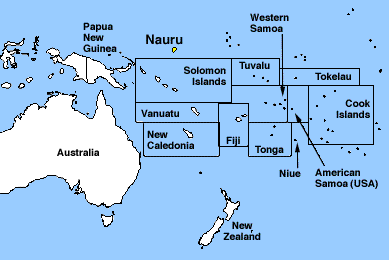
Nauru's only plane repossessed


The Republic of Nauru, an incredibly fake-sounding yet real Micronesian country, lost its only plane because corruption wiped out all its shit-brought wealth.
The remote Pacific island state of Nauru had its sole plane seized today, virtually cutting off the island’s residents from the outside world. The tiny island, whose people were once among the richest per capita in the world, had failed to make payments on the aircraft since 2002... The 7,500 residents of Nauru, a 21 square kilometre coral atoll, were once among the world’s wealthiest due to the export of phosphates, mostly from bird droppings. But the reserves are almost exhausted and with earlier wealth squandered through corruption and mismanagement, the country is virtually bankrupt.