Showing posts with label economist. Show all posts

Welcome aboard


The consistently serious newspaper's quirky attempt at humor:

Sep 7th 2006
From The Economist print edition

In-flight announcements are not entirely truthful. What might an honest one sound like?

“GOOD morning, ladies and gentlemen. We are delighted to welcome you aboard Veritas Airways, the airline that tells it like it is. Please ensure that your seat belt is fastened, your seat back is upright and your tray-table is stowed. At Veritas Airways, your safety is our first priority. Actually, that is not quite true: if it were, our seats would be rear-facing, like those in military aircraft, since they are safer in the event of an emergency landing. But then hardly anybody would buy our tickets and we would go bust.

The flight attendants are now pointing out the emergency exits. This is the part of the announcement that you might want to pay attention to. So stop your sudoku for a minute and listen: knowing in advance where the exits are makes a dramatic difference to your chances of survival if we have to evacuate the aircraft. Also, please keep your seat belt fastened when seated, even if the seat-belt light is not illuminated. This is to protect you from the risk of clear-air turbulence, a rare but extremely nasty form of disturbance that can cause severe injury. Imagine the heavy food trolleys jumping into the air and bashing into the overhead lockers, and you will have some idea of how nasty it can be. We don't want to scare you. Still, keep that seat belt fastened all the same.

Your life-jacket can be found under your seat, but please do not remove it now. In fact, do not bother to look for it at all. In the event of a landing on water, an unprecedented miracle will have occurred, because in the history of aviation the number of wide-bodied aircraft that have made successful landings on water is zero. This aircraft is equipped with inflatable slides that detach to form life rafts, not that it makes any difference. Please remove high-heeled shoes before using the slides. We might as well add that space helmets and anti-gravity belts should also be removed, since even to mention the use of the slides as rafts is to enter the realm of science fiction.

Please switch off all mobile phones, since they can interfere with the aircraft's navigation systems. At least, that's what you've always been told. The real reason to switch them off is because they interfere with mobile networks on the ground, but somehow that doesn't sound quite so good. On most flights a few mobile phones are left on by mistake, so if they were really dangerous we would not allow them on board at all, if you think about it. We will have to come clean about this next year, when we introduce in-flight calling across the Veritas fleet. At that point the prospect of taking a cut of the sky-high calling charges will miraculously cause our safety concerns about mobile phones to evaporate.

On channel 11 of our in-flight entertainment system you will find a video consisting of abstract imagery and a new-age soundtrack, with a voice-over explaining some exercises you can do to reduce the risk of deep-vein thrombosis. We are aware that this video is tedious, but it is not meant to be fun. It is meant to limit our liability in the event of lawsuits.

Once we have reached cruising altitude you will be offered a light meal and a choice of beverages—a word that sounds so much better than just saying ‘drinks’, don't you think? The purpose of these refreshments is partly to keep you in your seats where you cannot do yourselves or anyone else any harm. Please consume alcohol in moderate quantities so that you become mildly sedated but not rowdy. That said, we can always turn the cabin air-quality down a notch or two to help ensure that you are sufficiently drowsy.

After take-off, the most dangerous part of the flight, the captain will say a few words that will either be so quiet that you will not be able to hear them, or so loud that they could wake the dead. So please sit back, relax and enjoy the flight. We appreciate that you have a choice of airlines and we thank you for choosing Veritas, a member of an incomprehensible alliance of obscure foreign outfits, most of which you have never heard of. Cabin crew, please make sure we have remembered to close the doors. Sorry, I mean: ‘Doors to automatic and cross-check’. Thank you for flying Veritas.”

Hyperinflation in Zimbabwe


As a follow up to my previous post.

Bags of bricks

Aug 24th 2006 | JOHANNESBURG
From The Economist print edition

A most unusual shopping spree has just taken place in Zimbabwe. At the end of July the central bank devalued the Zimbabwean dollar (Z$) by more than half and then announced that the currency would also lose three zeros. This is the bank's latest idea to fight hyperinflation hovering around 1,000% a year—the highest in the world—and to attract cash into the banking system. Zimbabweans had until August 21st to get rid of the old bearer cheques used as banknotes. Whatever they could not exchange for the new currency, they spent. Gideon Gono, the governor of the central bank, suggested that the change be called “from zero to hero”.
Banks were swamped with customers trying to hand in their cash before the deadline. Anyone willing to deposit more than Z$100m ($400) a week—Z$5 billion for businesses—had to explain where the money came from or risk having it forcibly converted into one-year bonds or confiscated. New bearer cheques could be withdrawn against what had been deposited, subject to strict ceilings. The police searched people for large amounts of cash at roadblocks. Those stuck with extra money had to spend it before it became worthless. Shoppers frantically filled trolleys before the deadline.

In June it could buy a loaf of bread. Now it is worthlessSpiralling inflation has forced Zimbabweans to use bags to carry cash: wallets are a distant memory. It takes time for cash machines to spit out the daily maximum of Z$250m—or Z$250,000 in new money—that people are allowed to withdraw, so queues have become common. Zimbabweans have become used to dealing in “bricks”, as piles of banknotes worth Z$10m are known. Businesses send their money by trucks to banks' special bulk-cash facilities. Computer and accounting systems have been close to collapse, struggling to cope with sums in the trillions.

It is hard to see how scrapping three zeros and forcing people to bank their cash will stop prices spiralling. The central bank is calling for stringent monetary and fiscal policy, but has no power to force the government to tighten the purse strings. It partly blames inflation on speculation in the property and parallel foreign-exchange markets, but it has shown little restraint in printing money. Zimbabwe, the region's breadbasket before the government launched a disastrous land reform in 2000, is now hobbled by shortages of food, petrol, other basic commodities and hard currency. The economy has been contracting fast, and unemployment is estimated at over 70%. Many Zimbabweans rely on support from the 3m relatives or friends thought to have left the country.

Zimbabwe's woes cast serious doubt over the integration plans of the 14-country Southern African Development Community, which held a summit in Lesotho last week. Those attending voiced concern over Zimbabwe, which used to be the region's second-largest economy after South Africa. But it ended with the usual promises to speed up integration, create a free-trade zone within two years and establish a common currency by 2018. A common market, let alone a monetary union, looks like a distant dream. Probably not for the central bank's Mr Gono though: he expects Zimbabwe to have single-digit inflation by the end of 2008.

Soft paternalism


What often puzzles me about the political scene of Hong Kong is the utter lack of discussion on the philosophy of public policies. For instance, to take the easiest case, the motto of "small government" often chanted by legislators is not confined to governmental expenditure. Rather, it is the belief that the government's role should be limited to only where it is absolutely essential, that people should be trusted to live their life responsibly provided that the playing field is level and information for their decision-making is available. But I digress...

Here is an excellent article from the trusty Economist on an emerging trend of governance: Soft Paternalism.
The state is looking after you
Apr 6th 2006
From The Economist print edition

A new breed of paternalists is seeking to promote virtue and wisdom by default. Be wary

Liberals sometimes dream of a night-watchman state, securing property and person, but no more. They fret that societies have instead submitted to the nanny state, a protective but intrusive matriarch, coddling citizens for their own good. Economists, with their strong faith in rationality and liberty, have tended to agree. As many decisions as possible should be left in the individual's lap, because no one knows your interests better than you do. Most of us have gained from this freedom.

But a new breed of policy wonk is having second thoughts. On some of the biggest decisions in their lives, people succumb to inertia, ignorance or irresolution. Their private failings—obesity, smoking, boozing, profligacy—are now big political questions. And the wonks think they have an ingenious new answer—a guiding but not illiberal state.

What they propose is “soft paternalism”. Thanks to years of patient observation of people's behaviour, they have come to understand your weaknesses and blindspots better than you might know them yourself. Now they hope to turn them to your advantage. They are paternalists, because they want to help you make the choices you would make for yourself—if only you had the strength of will and the sharpness of mind. But unlike “hard” paternalists, who ban some things and mandate others, the softer kind aim only to skew your decisions, without infringing greatly on your freedom of choice. Technocrats, itching to perfect society, find it irresistible. What should the supposed beneficiaries think?

Choosing not to choose

Most people would accept that a healthy diet is hard to achieve, financial matters are confusing and cigarettes kill too many. The state is tempted to step in, not only because of the harm that smokers, lushes, spendthrifts and gluttons may do to others, but because of the harm they are doing to themselves. In Scotland last month the government banned smoking in offices, restaurants and pubs. In Massachusetts, the state legislature has passed a bill requiring everyone who can afford to buy health insurance to do so, on pain of higher taxes.

This is hard paternalism. The softer sort is about nudging people to do things that are in their best interests. The purest form involves setting up systems for sinners to reform themselves: in Missouri for instance, some 10,000 compulsive gamblers have banned themselves from riverboat casinos; if they succumb to their habit (and are caught) they face tough punishments. In most cases, though, soft paternalism means the government giving people a choice, but skewing the choice towards the one their better selves would like to make.

For instance, in many countries plenty of workers fail to enrol in pension schemes and suffer as a result. The reason is not that they have decided against joining, but that they haven't decided at all—and enrolling is cumbersome. So why not make enrolling in the scheme the default option, still leaving them the choice to opt out? Studies have shown this can nearly double the enrolment rate. Lord Turner, head of Britain's Pensions Commission, is the latest soft paternalist to recommend such a scheme.

Soft paternalists also want to give people more room to rethink “hot and hasty” decisions. They favour cooling-off periods before big decisions, such as marriage, divorce or even buying cigarettes. Some of them toy with elaborate “sin licences”, which would entitle the holder to buy cigarettes, alcohol or even perhaps fatty foods, but only at times and in amounts the licenceholder himself signed up to in advance.

If people want this kind of customised paternalism, why can't the market, in the shape of rehab clinics and personal trainers, provide it? Soft paternalists argue that, without the power of the state behind such schemes, they will often break down: the sovereign consumer can always veto his own decisions. He can fire his personal trainer or check out of the clinic. Long before the government took it upon itself to ban opium from general sale, Samuel Taylor Coleridge, a Romantic poet and drug addict, used to hire porters to bar his entry to apothecaries. But he would later threaten to have them arrested if they did not let him pass.

Letting the mice play

Soft paternalism has much in its favour. First, it is certainly better than hard paternalism. Second, a government has to provide information to citizens in order for them to make rational decisions on everything from smoking to breastfeeding to organ donation. Even a government reluctant to second-guess its citizens ends up advising them in one way or another. What people decide they want is often a product of the way a choice is framed for them—they take the first thing on the menu, or a bit of everything. Even a truly liberal government would find itself shaping the wishes and choices to which it earnestly wants to defer. It's surely better to lure people into pension schemes than out of them.

Yet from the point of view of liberty, there is a serious danger of overreach, and therefore grounds for caution. Politicians, after all, are hardly strangers to the art of framing the public's choices and rigging its decisions for partisan ends. And what is to stop lobbyists, axe-grinders and busybodies of all kinds hijacking the whole effort? There is, admittedly, a safety valve. People remain free to reject the choices soft paternalism tries to guide them into—that is what is distinctive about it. But though people will still have this freedom, most won't bother to use it—that is what makes soft paternalism work. For all its potential, and its advantage over paternalism of the hard sort, this is a tool that transfers power from the individual to the state, which only sometimes knows best.

Its champions will say that soft paternalism should only be used for ends that are unarguably good: on the side of sobriety, prudence and restraint. But private virtues such as these are as likely to wither as to flourish when public bodies take charge of them. And life would be duller if every reckless spirit could outsource self-discipline to the state. Had the government deprived Coleridge of opium, he might have been happier. Then again, there might have been no “Kubla Khan”.

The Democrats (and abortion rights) might be better off if Roe v Wade were overturned


Every once in a while I'd encounter an idea that is so brilliant yet simple and elegant, it would make me pause my day and dream about having that level of intelligence for a while. The following is the latest that hit me. It is about the Roe vs Wade decision that is a perennial hot button in American political skirmishes.


A heretical proposal
Dec 8th 2005
From The Economist print edition

Lexington

AS A general rule, Republicans are much happier with American exceptionalism than Democrats. Conservatives celebrate the right of every God-fearing American to carry a semi-automatic in his Kyoto-busting SUV while liberals protest that Europe is greener and safer. But when it comes to abortion, it is the Democrats who are the American exceptionalists.

Most rich countries other than the United States have solved the abortion problem by consulting the electorate—either through the legislature or through referendums. This led to vigorous debates and, broadly, the triumph of abortion rights. Because abortion was legalised democratically, pro-lifers accepted the fact that they had lost and abortion became a settled right. By contrast, in America, abortion is a fundamental right of privacy protected by a 1973 Supreme Court judgment—Roe v Wade.

Few objective outsiders—if it is possible to be such a thing on abortion—would argue that relying on judges rather than popular will has helped American politics: no other comparable country has such destructive culture wars. Roe left a large chunk of the country feeling disenfranchised by the court; it also established a cycle of attack and counter-attack that has debased everything that it has touched, especially the judiciary.

A prime example is the Roe-obsessed confirmation process for Supreme Court nominees. Samuel Alito, Mr Bush's new candidate, claims that the fact that he once advised the Reagan administration on how to overturn Roe will have no bearing on his behaviour on the court. No less disingenuously, liberal senators pretend they are trying to gauge Mr Alito's legal philosophy when they are trying to catch him out on Roe.

All this is bad for America; but, in political terms, Roe has been particularly disastrous for the Democrats. The Republicans have generally had the better of the abortion wars (something most liberals admit as long as nobody from NARAL Pro-Choice America is in the room). Roe has proved a lightning-rod for conservatives; and many moderates dislike the Democrats'Roe-driven defence of partial-birth abortions. So consider a heretical proposition: why on earth don't Democrats disown Roe?

Merely to mention this in public can be dangerous. Yet there are two obvious reasons for the party to do it. First, abortion rights command broad popular support in the United States, just as they do in Europe. Gallup polling since the mid-1970s has consistently shown that about 80% of Americans want abortion to be legal—either in all circumstances (21-31%) or in some circumstances (51-61%). Without Roe, abortion might be slightly restricted, but certainly not banned, as conservatives want.

Second, Roe is a pretty flimsy decision. The idea that the constitution protects “the right to privacy” was already something of a stretch when Justice William Douglas discovered it in the Griswold v Connecticut case in 1965. Ruling that the state government could not stop married couples from purchasing contraception, Douglas wrote that the right to privacy exists because the “specific guarantees in the Bill of Rights have penumbras, formed by emanations from those guarantees that help give them life and substance.” It was these penumbras and emanations that were stretched still further in 1973 when the court ruled on Roe.

Some Democrats say that they regard “a woman's right to choose” as analogous to a black person's right to vote—a basic human right that cannot be gainsaid by the electorate. This is far from convincing. The constitution is as clear about the right to vote—thanks to the equal protection clause—as it is murky on the right to abortion. And abortion isn't a clear-cut moral issue in the way that the franchise is. Bill Clinton never felt any need to argue that black voting should be “safe, legal and rare”.

A better argument in defence of Roe is that some states might well outlaw abortion. The Centre for Reproductive Rights claimed in 2004 that 21 conservative states were highly likely to do so and nine somewhat likely. But this presumes that public opinion has been frozen in aspic since 1973. Laura Vanderkam of USA Today points out that many of these “anti-Roe” states may well vote in favour of abortion rights: seven have Democratic governors, one (Rhode Island) is firmly in the Democratic column, and many others (Colorado, Ohio) cannot be relied upon to ban it. Moreover, the states that are most likely to vote to ban abortion—such as Mississippi and North Dakota—already have very few abortion clinics in any case: women who want abortions in those states already have to travel huge distances. Crossing state lines would not make that much difference.

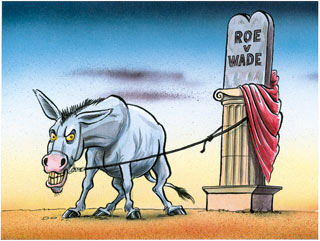
Stubborn as a mule

The main reason, alas, why Democrats will stick by Roe is simply because it is a totem in the culture wars. Why should pro-choice forces surrender any ground? That argument makes sense if you want to defend “choice” right into the ninth month, as some zealots do. But for most Democrats who merely want to keep abortion legal under most circumstances, that right would be more secure if it carried democratic legitimacy.

Embracing the democratic process would send a powerful signal that the Party of the People has rediscovered its faith in the people. Relying on judges to advance the liberal agenda allowed conservatives to seize the mantle of populism. Roe has given Republicans a free ride: they can claim to oppose abortion in the comfortable knowledge that it will never be banned. But imagine if Roe were overturned. How many Republicans would vote for a ban on abortion that only one in five Americans support? The conservative coalition would be split asunder.

History is full of great generals who won their wars by staging strategic retreats. Field-Marshal Kutusov allowed Napoleon to occupy Moscow, tempting him to over-extend himself. The Democrats might emulate that aged Russian's wiliness—and stage a strategic retreat to the high ground of popular opinion.